Semantic SEO & Topical Authority: The 2026 Blueprint for Michigan AI Optimization
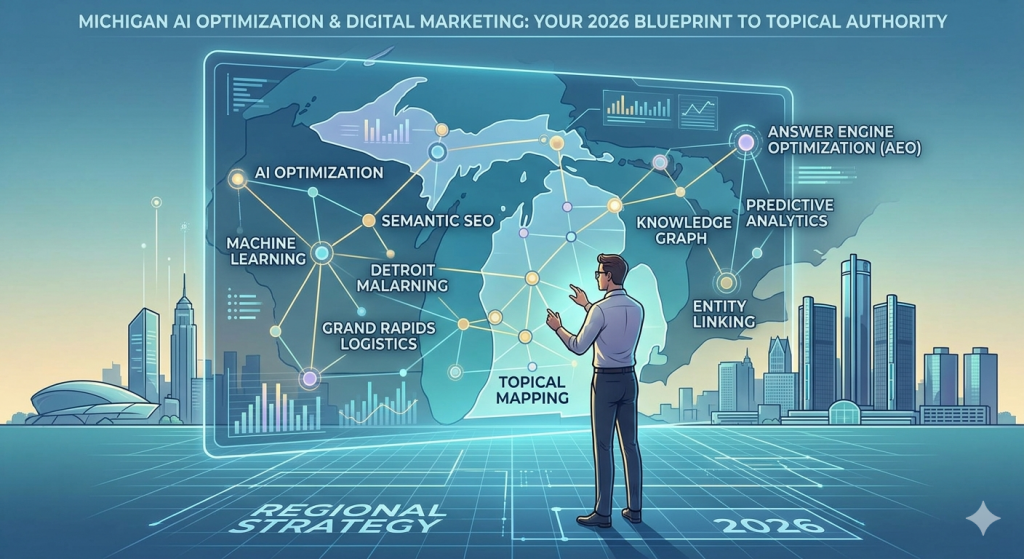
By MarketingBizUMD Published: April 2026
Introduction: The Death of the Keyword and the Birth of the Entity
For years, digital marketing in Michigan was a game of volume. If you sold “industrial sensors in Grand Rapids,” you simply repeated that phrase until Google noticed. But as we navigate 2026, the game has fundamentally changed. With AI assistants handling 25% of all global queries (Squarespace, 2026) and Google’s Search Generative Experience (SGE) dominating the top of every SERP, keywords have been relegated to the background.
Today, search engines don’t look for words; they look for Entities. They seek to understand the relationship between your brand, your location, and your expertise. This guide provides an exhaustive deep-dive into Semantic SEO—the process of building a “topical map” so comprehensive that AI engines cannot help but cite you as the primary authority in the Great Lakes region.
I. Understanding the Semantic Shift: Why Keywords Aren’t Enough
In 2026, we operate in an era of Intent Intelligence. Traditional SEO was like a library index; Semantic SEO is like the librarian who has actually read every book and understands the context.
The Knowledge Graph & Entity-Based SEO
Search engines now utilize a Knowledge Graph—a massive database of entities (people, places, things, and concepts) and their connections. For a Michigan business, your “Entity” isn’t just your website URL. It is your physical location in Macomb County, your CEO’s LinkedIn profile, your mentions in the Detroit Free Press, and your relationship to “Advanced Manufacturing.”
“Entity clarity is the new merchant’s seal. When a search system can definitively link a founder to a role and a company to a specific solution, trust is established. Without entity clarity, you are invisible to AI agents.” — Udjat Agency, Advanced SEO Trends 2026.
The “Citation Premium” in AI Overviews
Recent data shows that 76.1% of AI Overview citations come from pages already ranking in Google’s Top 10 (The Digital Bloom, 2026). However, there is a catch: while traditional organic CTR has plummeted by 61% due to AI summaries, AI search visitors convert 23x better than traditional organic visitors (Ahrefs, 2025).
The takeaway? You might get fewer clicks, but the people who do click are pre-vetted by the AI and ready to buy. To get that citation, you need Topical Authority.
II. Building a Michigan-Specific Topical Map
Topical authority is not about writing one good blog post; it’s about covering every possible question a user might have about a subject. In Michigan’s 2026 economy—heavily focused on EV materials, healthcare, and fintech—your topical map must reflect regional nuances.
1. Identifying Your Seed Entity
Instead of a “seed keyword,” choose a “seed entity.”
- Bad: “Michigan SEO services”
- Good: “AI-driven digital transformation for Michigan manufacturing”
2. The Cluster-Spoke Model 2.0
To dominate Michigan AI optimization, your site must be structured into logical clusters. Let’s look at a topical map for a Michigan B2B firm:
| Cluster Hub | Supporting “Spoke” Articles (LSI Focused) | Target Entity Connections |
| AI Optimization | Predictive analytics for Detroit automotive; Machine learning in Grand Rapids logistics; AEO (Answer Engine Optimization). | Google Gemini, OpenAI, Michigan Tech University. |
| Digital Marketing | Programmatic ad spend for MI healthcare; Regional sentiment analysis; Hyper-local SEO for the 83 counties. | MEDC, Grand Rapids Chamber, Detroit Prosperity Region. |
| Data Privacy | Compliance with Michigan’s 2026 video privacy laws; First-party data strategies for MI retail. | VPPA, Nessel Lawsuits (2026), GDPR/CCPA. |
3. Semantic Internal Linking
Internal links are the “synapses” of your topical map. In 2026, you must avoid generic anchor text like “click here.” Use Descriptive Semantic Anchors.
- Example: Instead of “our services,” use “advanced AI optimization for Ann Arbor tech startups.” This tells the AI exactly how the two entities are related.
III. Technical Execution: Schema, NLP, and Data Structures
You cannot have topical authority without a technical foundation that “speaks” AI. This is where most Michigan digital marketing agencies fail—they focus on the prose but ignore the plumbing.
Advanced Schema Markup (JSON-LD)
In 2026, Schema.org is the primary language search engines use to verify entities. Your website must include:
- Organization Schema: Defining your Michigan headquarters, social profiles, and founders.
- SubjectOf Schema: Linking your blog posts to the specific entities they discuss.
- Speakable Schema: Helping AI assistants like Gemini and Siri read your content aloud.
Natural Language Processing (NLP) Optimization
AI engines use NLP to determine if your content is written by a human expert or a generic bot.
- Use the Inverted Pyramid: Place the answer to the query in the first 100 words. This increases your chances of being the “featured snippet” in an AI Overview.
- Entity Density over Keyword Density: Mention related concepts naturally. If you are talking about “Michigan SEO,” you should naturally mention “Core Web Vitals,” “Search Console,” and “local search intent.”
Expert Insight: “In 2026, the ‘AI Freshness Gap’ is real. 65% of AI bot hits target content published within the last 12 months. If your topical map hasn’t been updated since 2024, you’ve already lost your authority status.” (Seer Interactive, 2025).
IV. UX Best Practices for Long-Form Authority Content
A 3,000-word article is useless if the reader bounces after 10 seconds. In Michigan, where business leaders are time-poor, your UX must facilitate “rapid value extraction.”
1. The “Skim-First” Hierarchy
Use nested headings (H1 > H2 > H3) and frequent “Summary Boxes.”
- The 3-Second Rule: Can a user understand the value of a section just by looking at the H2 and the first bulleted list?
- Visual Breaks: Every 300 words, include a table, quote, or image to prevent “wall-of-text” fatigue.
2. Interactive FAQ Sections
Use accordions to answer “People Also Ask” questions. This not only improves UX but also provides the structured data that Answer Engine Optimization (AEO) requires.
Common Michigan AI Optimization FAQs:
- How does SGE affect Detroit local businesses?
- What is the ROI of AI-driven content clusters?
- How can I track “Brand Mentions” if clicks are down?
3. Mobile-First Interactivity
With 41% of Michigan’s population residing in the Detroit Metro Prosperity Region, and mobile usage at an all-time high, your site must load in under 1.2 seconds.
- Tool Tip: Use AI-powered image compression to ensure your high-res diagrams don’t kill your Core Web Vitals.
V. Case Study: Transforming a Grand Rapids Manufacturer
Let’s look at how this works in practice. A Grand Rapids-based furniture component manufacturer shifted their strategy from “office chair parts” (keyword) to “Sustainable Ergonomic Office Engineering” (entity).
- Phase 1 (The Map): They created 30 articles covering the lifecycle of sustainable materials, ergonomic health studies, and Michigan-based supply chains.
- Phase 2 (The Schema): They tagged every article with
AboutandMentionsschema, linking to the Michigan Department of Labor and Economic Opportunity. - Phase 3 (The Result): Despite a 20% drop in total organic traffic, their high-intent leads increased by 45%. The AI assistants were now recommending them as the “Top-rated sustainable manufacturer in Michigan” for B2B queries.
VI. The 2026 Roadmap to Authority
To implement these semantic ideas, follow this 12-week sprint:
- Weeks 1-2: Entity Audit. Use Google’s Natural Language API to see how the web currently “categorizes” your brand.
- Weeks 3-6: The Topical Map. Build out the 20+ supporting articles needed to cover your niche.
- Weeks 7-9: Technical Injection. Implement advanced JSON-LD and optimize site speed for 2026 standards.
- Weeks 10-12: The Citation Push. Reach out to Michigan-based journals and associations to build “Entity Links” (mentions without the need for a backlink).
VII. References & Reputable Citations
- WSI World. (2025). Marketing & AI Predictions That Will Shape Search in 2026. wsiworld.com/blog
- The Digital Bloom. (2026). 2026 AI Citation Position & Revenue Report. thedigitalbloom.com/learn
- Michigan Department of Labor and Economic Opportunity. (2026). Michigan Center for Data and Analytics: 2026 Labor Market News. michigan.gov/mcda
- Ahrefs. (2025). The Impact of AI Overviews on Organic CTR and Conversion Rates.
- Digital Marketing Institute. (2026). 10 Eye-Opening AI Marketing Stats to Take Into 2026. digitalmarketinginstitute.com/blog
- Michigan Economic Development Corp (MEDC). (2026). Michigan’s Tech Sector Growth: Site Selection Rankings. michiganbusiness.org/press-releases
Final Thought for Michigan SEOs
In 2026, your authority is not what you say it is; it’s what the Knowledge Graph says it is. By focusing on semantic relationships and topical depth, you aren’t just chasing an algorithm—you are building a resilient digital asset that survives the AI revolution.
Ready to dominate? Let’s discuss how to map your specific Michigan industry into the global Knowledge Graph.

Leave a Reply